
Students at the University of Maryland’s Listening Garden.
By: Alden E. Stoner, CEO, Nature Sacred; and Marc Berman, PhD, author of Nature and the Mind and long-time Nature Sacred collaborator.
College campuses are places of discovery and human connection. But increasingly, they’re also places of anxiety and isolation. As people who’ve spent decades listening to young people, we see them struggling with unprecedented mental health challenges while universities search for effective ways to support their wellbeing.
The good news? In a world where many societal level challenges seem overwhelmingly complex, one intervention is hiding in plain sight. It’s neither tech-born nor cost prohibitive. Nearby nature.
A walk in a park; a quiet moment on a bench, beneath a tree. Marc’s research has demonstrated that the moments we spend in nature literally change our minds, helping us to focus better, but also change what we think about. Marc and his team have found that interacting with nature can increase our abilities to focus and also cause us to think more reflectively, more positively, and less about ourselves. For close to three decades, Nature Sacred has seen this science reflected in the thousands of anonymous journal entries left in what we call Sacred Places, community-led green spaces designed to support mental health and well-being, across the country.
In journal entries left in the Sacred Place at the University of Maryland in College Park, we’ve read entries like “…there is always a light, if we look for it” and “This too shall pass…” These messages of resilience and hope accumulate across the country in Sacred Places.
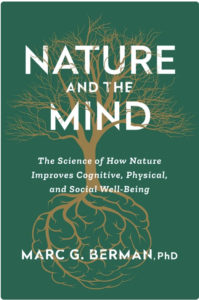 Nature Sacred has spent decades supporting the creation of these spaces and seeking a deeper, more nuanced understanding of their impact on people and communities, which led us to support Marc’s research more than a decade ago, work now featured in his new book “Nature and the Mind: The Science of How Nature Improves Cognitive, Physical, and Social Well-Being.” Sacred Places, and journal entries gathered in them, appear as a key case study, illustrating how green space design elements can measurably shape human thought and well-being, work that Marc and his team took from correlational into causal with their follow-up experiments.
The timing couldn’t be more critical. College students have rising rates of mental health problems, with anxiety and depression reaching crisis levels across campuses. There are additional problems with rising levels of attention problems where ADHD rates have also spiked. While the reasons are many, we can begin to address the issue even without waiting for consensus on the why.
Marc’s research focuses in large part on attention. Not only does attention help us focus on work or school, but it’s also crucial for impulse control, self-regulation and mental health. When people are depressed, negative thoughts tend to occupy more of their attention, making them less able to focus on other topics. Nature is uniquely capable of restoring our attention because it’s full of sights and sounds that are gently interesting without demanding our full attention, hitting a sweet spot between interest and boredom.
And here’s something most people find surprising: You don’t even need to like nature to get the cognitive benefits, and you don’t need to be physically active. Just sitting and observing a bit of nature is good for your mind. Importantly, many of the participants in Marc’s studies are students who live on various college campuses across the U.S., where Marc and his team have demonstrated significant impacts on mental health.
And now, more campuses are beginning to put this science into practice. Last fall, Jacksonville State University in Alabama opened a new Sacred Place. It was created by students and staff supported by Nature Sacred and the Community Foundation of Northeast Alabama. The space gives students a dedicated spot to pause, reflect, and connect with one another and with nature.
The university’s counseling services, deeply involved in the creation of the space, are planning to host mindfulness workshops and relaxation exercises there.
The purpose of Sacred Places like the one at University of Maryland and Jacksonville State University isn’t just beauty. It’s about recognizing that nature is not a luxury but a necessity, one more way that colleges can support students’ mental health and wellbeing.
The science demonstrates why it works. The journals document that it does. Together, they suggest that we should provide more opportunities for nature to do its quiet work in students’ lives.
—